Afghanistan is going through one of the most crucial phases of its economy. Since 2002, the private sector in the country has flourished and more than US$12.1 billion have been registered as initial capital for investments, whereas the actual investments could reach to US$25-30 billion, in all 6 major sectors of the economy.
Afghanistan since a decade and half has made enormous progress across all sectors that continues today under the pro-business and investment leadership of the National Unity Government. We are building infrastructure, bringing major reforms in our justice system, fighting corruption, building institutions, over 9 million go to school, addressing women violence and opening up new opportunities for women, forging regional economic and trade partnerships, and capitalizing on our abundant natural resources and advantageous position at the heart of Central, South, and East Asia.
The major sectors of the economy are; agriculture; industry, and services. Over the last more than a decade growth has largely been concentrated in four sectors: transport & communications; construction; manufacturing and government services. However, in the last five years, the Afghan economy has begun to diversify its economic sectors. Key areas of new growth include Carpets, Cashmere; Rolled steel; Mining; Agri-business; Marble and construction materials; Medicinal plants; Fresh and dried fruits; Aviation; and Telecoms.
In October 2016, the Government presented the new Afghanistan National Peace and Development Framework (ANPDF) at the Brussels Conference on Afghanistan (BCA). At the conference, attended by representatives of around 70 countries and 30 international organizations, development aid of $3.8 billion per year was committed to support the government reform agenda and economic-driven foreign policy.
With significant reform efforts and donor support, Afghanistan has maintained macroeconomic stability, implemented important structural reforms, built policy buffers and a comfortable reserve position, lowered debt and inflation, created a balanced budget, and made progress toward achieving social and development objectives, including the Millennium Development Goals (MDGs).
On July 29, Afghanistan reached an economic milestone by becoming the newest member of the World Trade Organization. In doing so, we reaffirmed our commitment to free-market principles. There has never been a better time to invest in or do business with Afghanistan. As we grow, you grow.
The links below contain all the information you need to get started.
Other Supporting Links:
• MoCI: Ministry of Commerce and Industries of Afghanistan
• MoMP: Ministry of Mining and Petroleum
• MAIL: Ministry of Agriculture, Irrigation and Livestock
• MSP:
• MoPW: Ministry of Public Works
• MoFA:
Main Arguments to Invest in Afghanistan:
Since 2002, the economy has been growing at more than 10% per year. This growth has been volatile – in part because of a continued reliance on agriculture (still 23% of GDP) which is subject to weather-related fluctuations – with very high rates of 21% recorded in 2009 and 14.4% in 2012 and lower rates of 6.1% and 4.2% recorded in 2011 and 2013. The economy is forecast to grow by 2.6% in 2017 only slightly changed from what was achieved 2.2% in 2016. GDP is now $20.3 billion (2017) with per capita income of $614 per year. The major sectors of the economy are; agriculture 23%; industry: 21.1%; Services: 51.6% and tax on import 4.2%. Over the last more than a decade growth has largely been concentrated in four sectors: transport & communications; construction; manufacturing and government services. However, in the last five years, the Afghan economy has begun to diversify away from traditional areas. Key areas of new growth include Cashmere; Rolled steel; Mining; Agri-business; Marble and construction materials; Medicinal plants; Fresh and dried fruits; Aviation; and Telecoms.
Afghanistan’s Government continued to pursue its ambitious reform agenda. In October 2016, the Government presented the new Afghanistan National Peace and Development Framework (ANPDF) at the Brussels Conference on Afghanistan (BCA). At the conference, attended by representatives of around 70 countries and 30 international organizations, development aid of $3.8 billion per year was committed. Recent growth rates are likely to be sustained in the future and may even increase as a result of population growth of 2.4%, development of Afghanistan’s mining and petroleum sectors which have been valued to $3 trillion. Having said that, there are plentiful counter factors which encourage investors to invest in Afghanistan. They are explained below:
1. Commitment to Private Sector Development
The Government has adopted a pro-private sector stance and a liberal trade regime and has taken many steps to create attractive conditions for foreign investment including; ensuring fiscal and economic stability, creating a stable currency and liberal foreign exchange regime, simple, low, cost-effective taxation arrangement, an open liberal trading regime, an open, liberal investment regime, a modern legal framework.
2. Creating the Infrastructure for Growth
The Government takes seriously its responsibility to ensure that infrastructure is adequate and that necessary skills and services are readily available. Since 2002 it has built the basic infrastructure necessary to support a modern economy in terms of roads, electricity, and water and railways which include Ring Road around Afghanistan which has been open for a number of years. New generation capacity will be opening this year in a number of areas and improved transmission lines have enabled increased imports of electricity from neighbouring countries. A railway link connecting Afghanistan to Uzbekistan’s rail network and to regional markets in Europe and Asia has been completed, building six industrial parks which are now operational in Kabul, Kandahar, Herat, Helmand, Bagrami, and Mazar-i-Sharif.
3. Growth in Exports
Exports have grown strongly albeit from a low base rising from $69 million in 2002 to $596 million in 2016. The Government sees increasing non-mineral exports as a central plank of its economic development strategy. Significant donor support is available to help businesses – particularly SMEs – enter into new markets. Dry fruits, carpets, medicinal plants, and animal by-products (such as wool, skin, etc.) were some of the items that saw a major increase in recorded exports. Other key exports include carpets, marble, and fruit. Afghanistan has signed a number of free trade agreements including joining the South Asia Free Trade Agreement, Trade and Transit Agreement, with Pakistan and a Preferential Trade Agreement with India. Afghanistan has joined the multilateral trading system of World Trade Organization (WTO) recently. It has preferential access to a number of large markets in the developed world including the USA and Europe under anything but arms arrangements. Afghanistan‘s top export markets are India, Pakistan, UAE, Iran, Saudi Arabia, Central Asia and the EU.
4. Continued Support from Donor Community
Increasingly donors see sustainable economic growth as critical to Afghanistan’s long-term prospects. As a result, substantial levels of aid are being directed towards this end including World Bank and USAID and other donors support
1. Investment Opportunities in Afghanistan
Afghanistan offers very good opportunities for the investors to invest in this country. These opportunities are indicated as below:
More detail on investment climate and opportunities from the Afghanistan Investment Support Agency: http://investinafghanistan.af/en/
http://www.doingbusiness.org/data/exploreeconomies/afghanistan/
B. A. Investment Opportunities in Afghanistan
Afghanistan offers very good opportunities for the investors to invest in this country. These opportunities are indicated as below:
More detail on investment climate and opportunities from the Afghanistan Investment Support Agency: http://investinafghanistan.af/en/
http://www.doingbusiness.org/data/exploreeconomies/afghanistan/
The bellow-given link to “Investment in Afghanistan” video should be put in play on the introduction page of the business and investment section.
https://www.youtube.com/watch?v=proiFtFYMq
Doing Business Law Library – Afghanistan:
Links to business laws and regulations collated by the World Bank and Ministry of Commerce and Industries. Topics include:
Ministry of Commerce and Industries. http://moci.gov.af/en/page/7565
• Law of Investment
• Law of Commerce
• Law of Commercial Arbitration
• Law of Tax on Consumers and Goods
• Law of Petroleum and Gaz
• Law of Business Trademarks
World Bank: http://www.doingbusiness.org/law-library/afghanistan
• banking and credit laws
• bankruptcy and collateral laws
• commercial and company laws
• labour laws
• land and building laws
• securities laws
• tax laws
• trade laws
LANGUAGE SELECTION
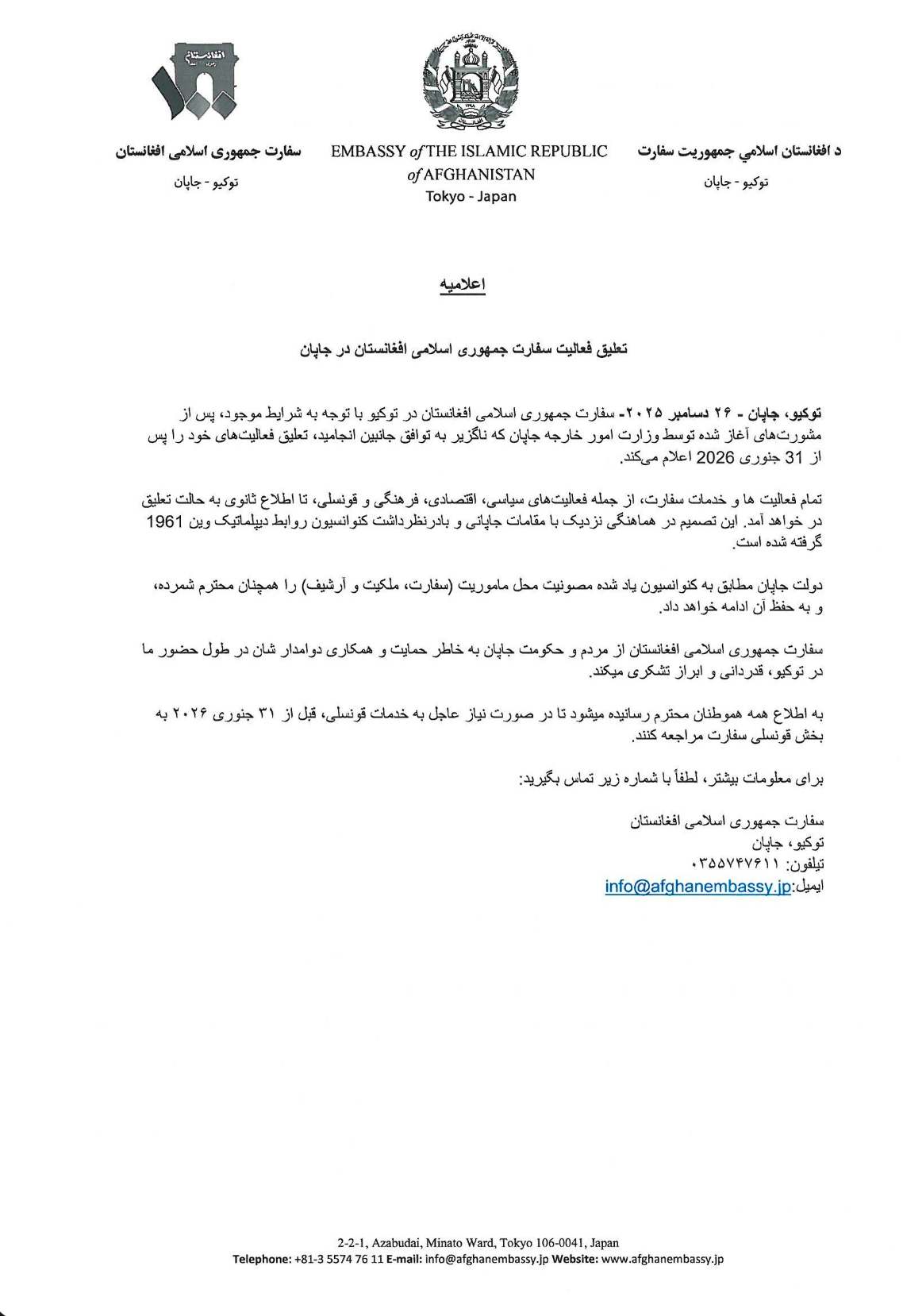
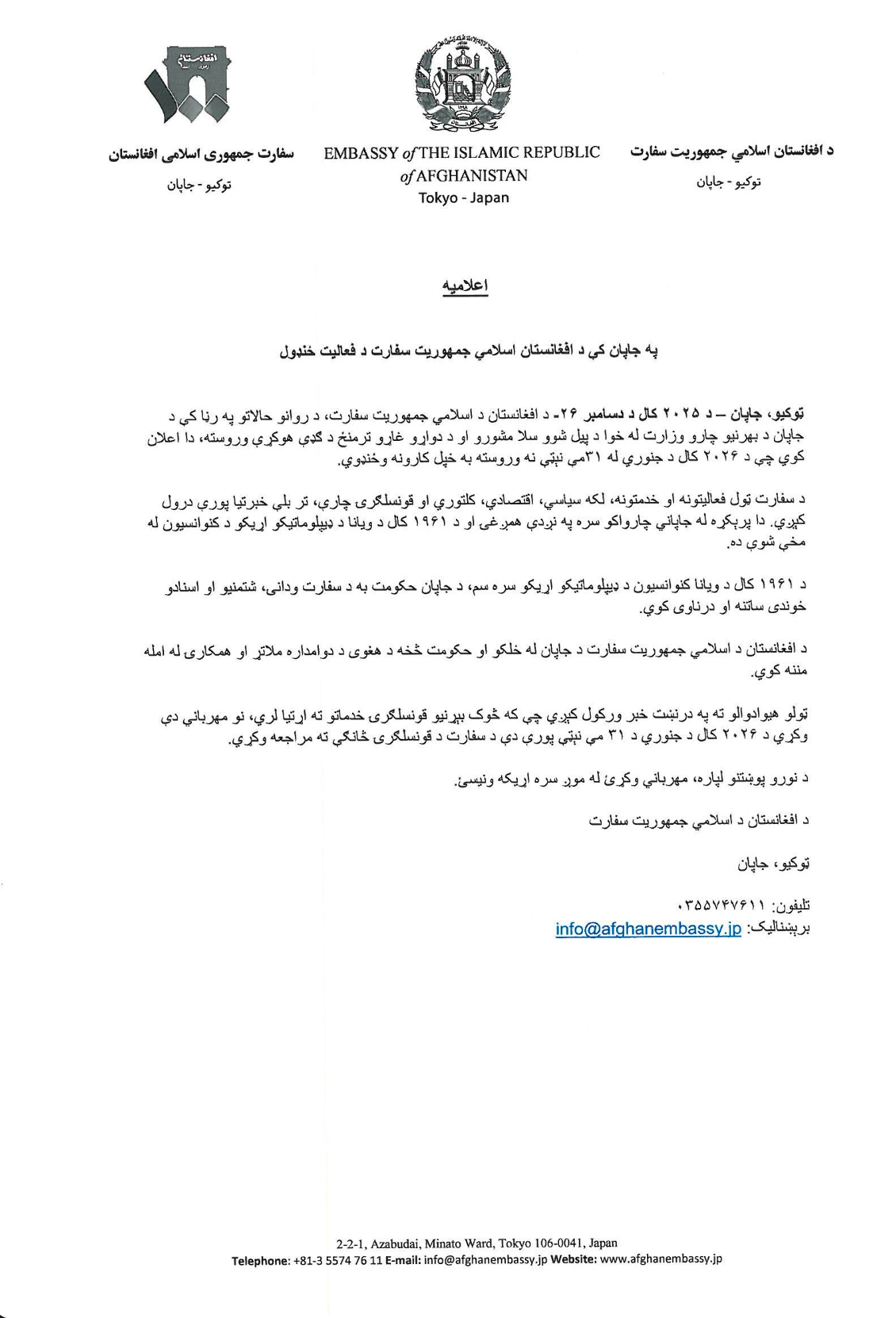
خبرتیا
پۀ جاپان کې د افغانستان سفارت خپلو درنو هېوادوالو ته خبر ورکوي چې د نوي میلادي کال د رخصتیو پر مهال به د سفارت دروازې خلاصې وي. سفارت به هره ورځ، پرته له شنبې او یکشنبې، د سهار له ۱۰:۰۰ بجو څخه دماځیګر تر ۴:۰۰ بجو پورې د قونسلي خدمتونو لپاره پرانیستی وي.
د نورو معلوماتو او قونسلي خدمتونو لپاره مهرباني وکړئ د ۰۳۵۵۷۴۷۶۱۱ شمېرې ته زنګ ووهئ او یا Info@afghanembassy.jp ته برېښنالیک واستوئ.
⸻
اطلاعیه
سفارت افغانستان در توکیو به اطلاع هموطنان گرامی میرساند که در ایام رخصتی های سال نو میلادی، سفارت باز میباشد. خدمات قونسلی همه روزه طبق معمول از ساعت ۱۰:۰۰ صبح الی ۴:۰۰ بعد از ظهر ارائه میگردد، به استثنای روزهای شنبه و یکشنبه.
جهت معلومات بیشتر و دریافت خدمات قونسلی، لطفاً به شماره ۰۳۵۵۷۴۷۶۱۱ تماس گرفته و یا از طریق ایمیل Info@afghanembassy.jp با سفارت در تماس شوید.